


Executive summary
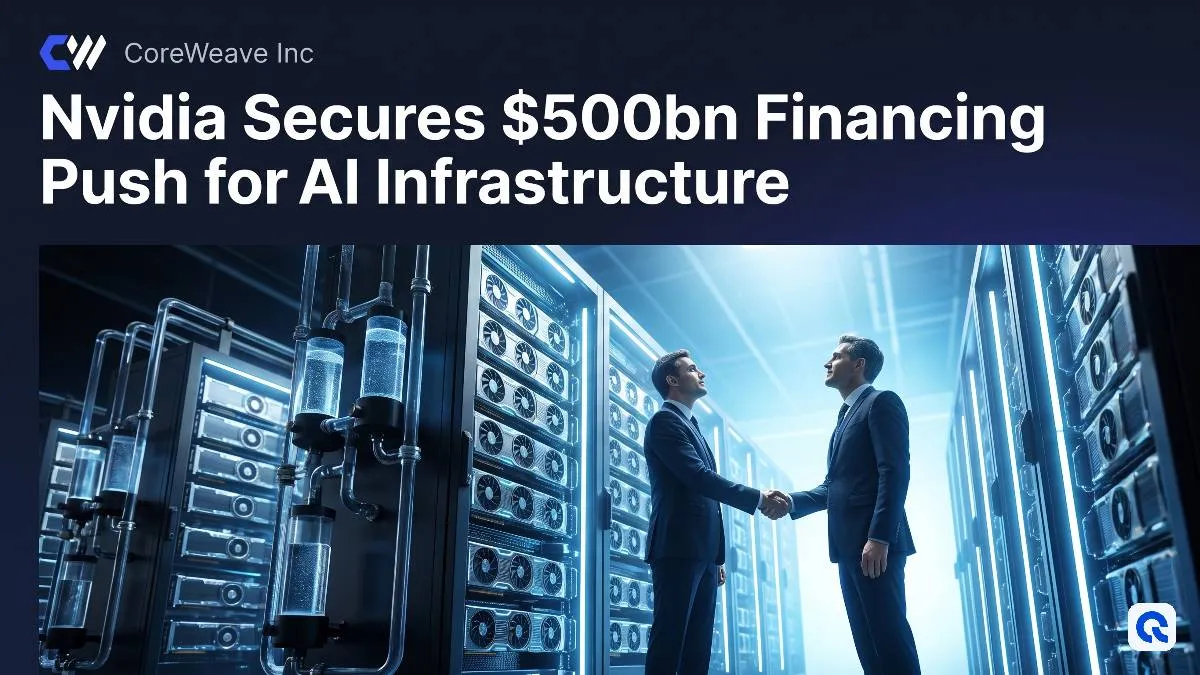
Nvidia announced partnerships with Apollo, BlackRock, Blackstone, Brookfield, Goldman Sachs, and KKR to create financing platforms targeting over $500 billion in third-party capital for AI infrastructure. The initiative aims to reposition GPUs as long-term, revenue-generating assets similar to toll roads or power plants, enabling customers to finance data centers without straining their balance sheets.
What happened
Nvidia signed memorandums of understanding with six prominent Wall Street asset managers to establish financing platforms for AI infrastructure. The partnerships aim to mobilize more than $500 billion in institutional capital from insurance funds, retirement accounts, and private credit sources. The financing is intended for hyperscalers, AI labs, and enterprises building data centers and purchasing Nvidia hardware. CEO Jensen Huang positioned the initiative as treating AI compute as productive infrastructure rather than rapidly depreciating equipment. Nvidia may provide residual-value support covering up to 25% on select projects to backstop hardware values. The announcement follows growing concerns about Big Tech's mounting AI spending, with Goldman Sachs estimating that AI-related financing now accounts for nearly one-quarter of all gross U.S. investment-grade issuance. AI investment is approaching $600 billion in 2025.
Why it matters
The financing initiative addresses a critical challenge for AI infrastructure companies: securing capital for massive data center buildouts without exhausting their own balance sheets. For CoreWeave and similar GPU cloud providers, this creates new pathways to finance capacity expansion through institutional debt markets rather than relying solely on equity or traditional bank loans. The partnerships validate the concept of AI compute as a financeable asset class, potentially lowering capital costs for infrastructure providers who can demonstrate stable utilization and cash flows. However, the model depends heavily on GPUs maintaining residual value over extended periods. If newer chip architectures rapidly depreciate older hardware, leveraged financing structures could face stress. Rating agencies including Moody's have already warned that AI spending is squeezing free cash flow across the sector and pushing companies toward heavier debt loads.
Bigger picture
The announcement reflects a fundamental shift in how AI infrastructure gets funded, moving from corporate cash flows to leveraged institutional capital. BlackRock CEO Larry Fink compared the initiative to the creation of mortgage-backed securities in the 1970s, framing it as the start of a new era of financial engineering around technology assets. Alternative asset managers have been actively seeking digital infrastructure opportunities, with Apollo and Blackstone already arranging financing for companies including Anthropic. The scale is unprecedented: the $500 billion target roughly equals Norway's annual GDP. Critics, including investor Michael Burry, have questioned whether the model creates systemic risk similar to pre-2008 securitization structures, particularly if GPU residual values prove unstable or if heavily financed customers struggle to monetize capacity. Goldman Sachs CEO David Solomon stated the Wall Street firms approached the financing project at Huang's initiative, reflecting Nvidia's strategic push to sustain demand growth as chip purchases reach extraordinary levels.
What to watch
Monitor whether final agreements and specific terms get disclosed by the participating asset managers, including risk-sharing arrangements, covenants, and technology refresh provisions. Track rental prices and utilization rates for older GPU models to assess whether residual-value assumptions hold as newer architectures emerge. Watch for the first major financing deals to close and how they perform, particularly customer payment patterns and any early defaults. Nvidia reports fiscal second-quarter results on August 26, which may provide insight into data center demand trends and whether infrastructure financing is broadening genuine end-market growth. Pay attention to rating agency commentary on how AI-related debt issuance affects credit profiles across the sector. The extent of Nvidia's direct financial support through residual-value guarantees will be critical in determining whether the company is effectively taking on off-balance-sheet risk.
Get our top market beating stocks free here
#infrastructure
#sector
#debt
#financing
